
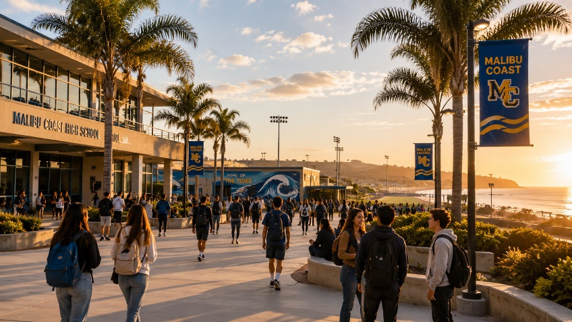
Every high school needs a place that is not officially part of campus but somehow belongs to the students anyway.
For Malibu Coast High, that place is Breaker Grill.
Tucked close enough to school that students can drift there after practice, games, club meetings, and long afternoons they are not ready to take home yet, Breaker Grill is more than a burger place. It is the unofficial second hallway of Malibu Coast High—the place where conversations keep going after the final bell, where football players decompress after practice, cheerleaders grab food between obligations, and friends slide into familiar booths pretending they only came for fries.
Inside, the room feels warm, crowded, and alive. Booths line the walls and windows. Small tables fill the center. The counter stays busy with orders, milkshakes, cold drinks, and baskets of food passed across to students who know exactly what they want before they reach the register. Two large televisions glow above the noise, sometimes showing sports, sometimes school highlights, sometimes the kind of thing everyone claims not to be watching until something important happens.
But the walls may be the real heart of the place.
Breaker Grill remembers.
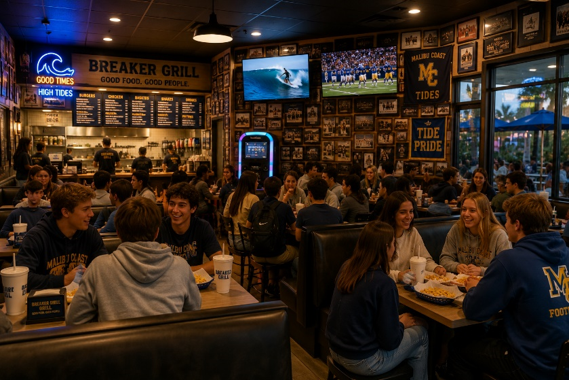
Framed photographs, old team pictures, homecoming moments, cheer squad snapshots, newspaper clippings, and school memorabilia cover the space with years of Malibu Coast history. Students walk in and see proof that other classes came before them, stood in the same booths, won games, lost games, fell in love, broke up, made mistakes, and eventually moved on. That matters in a series like Malibu Tides, where senior year is always carrying the ache of becoming memory before anyone is ready.
For Jason, Breaker Grill can be both escape and pressure. He may come in wanting a meal after practice, only to find his future discussed from three tables away. For Ava, it is a place where polished composure can slip, if only for a moment. For Riley, it reflects the practical side of student life—food grabbed quickly, schedules watched carefully, and conversations squeezed between responsibilities. For Noah, it is visual gold: faces, history, movement, timing, and the constant temptation to capture more than he probably should.
That is what makes Breaker Grill work as a setting. It is public enough that secrets are difficult, but familiar enough that private moments still happen. A conversation in a corner booth can change the tone of an entire chapter. A song from the jukebox can shift the mood. A glance across the room can say more than anyone is ready to admit.
Breaker Grill is not glamorous. It is not trying to be.
It is burgers, shakes, fries, team sweatshirts, crowded tables, and old photos on the wall. It is a safe place with rules, adults who pay attention, and students who still feel as if the room belongs to them. It is where school life becomes personal.
In Malibu Tides, the beach may hold the big emotional moments, and the football stadium may hold the roar of Friday night, but Breaker Grill holds something quieter.
It holds the conversations afterward.
The ones that start with, “Are you okay?”
The ones that end before anyone says enough.
The ones that keep senior year alive, one table at a time.